
Tech Note B008-25: Basic C-Shaped Wall Stud Behavior
$5.00
This Tech Note Updates and Replaces Tech Note B008-20
Summary: Although cold-formed steel framing shares some limit states with hot-rolled steel, cold-formed steel framing and specifically C-Shaped studs exhibit unique behaviors when subjected to various loading conditions. This Tech Note gives an overview of those unique behaviors that need to be considered when designing C-Shaped cold-formed steel members.
Disclaimer: Designs cited herein are not intended to preclude the use of other materials, assemblies, structures or designs when these other designs demonstrate equivalent performance for the intended use. CFSEI documents are not intended to exclude the use and implementation of any other design or construction technique.
Related Products
Tech Note D100-23: Corrosion Protection of Fasteners
This Tech Note Updates and Replaces Tech Note D100-13
Summary: Moisture, airborne chemicals and pollutants can all combine to reduce the life of ferrous fasteners through corrosion. This Technical Note examines the corrosion process, available fastener finishes, methods of measuring corrosion and the relative durability of fastener finishes.
Disclaimer: Designs cited herein are not intended to preclude the use of other materials, assemblies, structures or designs when these other designs demonstrate equivalent performance for the intended use. CFSEI documents are not intended to exclude the use and implementation of any other design or construction technique.
Tech Note L101-23: Design of Cold-Formed Steel Sheet and Wood Structural Panel Sheathed Shear Walls for Wind and Seismic Forces
Summary: This Technical Note provides an overview of low seismic and wind-controlled steel sheet and wood structural panel sheathed cold-formed steel (CFS) framed shear wall designs. It is a digest of the AISI D113-19, Cold-Formed Steel Shear Wall Design Guide and presents a more basic overview of design considerations. Sample shear wall capacity and loading comparisons are provided. For detailed design examples, refer to the AISI D113-19.
Code references are limited to AISI S240-15, North American Standard for Cold-Formed Steel Structural Framing; more detailed references, including AISI S400-15, North American Standard for Seismic Design of Cold-Formed Steel Structural Systems for high seismic design requirements can be found in the AISI D113-19.
Disclaimer: Designs cited herein are not intended to preclude the use of other materials, assemblies, structures or designs when these other designs demonstrate equivalent performance for the intended use. CFSEI documents are not intended to exclude the use and implementation of any other design or construction technique.
Tech Note T202-20: Thermal Energy Transfer of Cold-Formed Steel Framing
Summary: While the concepts of energy conservation and efficiency are not new, the demand for sustainable building is at an all-time high. Energy efficiency, and more specifically thermal energy transfer in steel stud construction, presents the construction team with a clear opportunity for reduction in thermal bridging. Advanced analysis of building thermal simulation through scientific thermal modeling programs illustrates that the construction team has the ability to significantly reduce thermal transfer. Use of cold-formed steel framing with a reduced thermal bridging area, in combination with increased spacing of the framing system provides, among other benefits, a significant and positive impact on thermal performance.
Disclaimer: Designs cited herein are not intended to preclude the use of other materials, assemblies, structures or designs when these other designs demonstrate equivalent performance for the intended use. CFSEI documents are not intended to exclude the use and implementation of any other design or construction technique.
Tech Note 562-22: Powder-Actuated Fasteners in Cold-Formed Steel Construction
This Technical Note updates and replaces Tech Note 562
Summary: Power-actuated fasteners (PAF’s) are industry standard for attachment of cold-formed steel (CFS) steel framing members, usually track, to concrete, CMU or steel structural elements. “Power-actuated” is the broad category used to refer to fasteners which are driven directly through the CFS and into the substrate, using a powder, gas, compressed air or electro-mechanically driven tool. Efficient installation of framing systems is greatly enhanced by the use of PAF’s. For CFS-to-steel applications, the specification AISI S100 addresses all relevant limit states with equations and safety/ resistance factors. For CFS-to-concrete, limited guidance is provided but not all limit states are covered. This technical note will provide design guidance based on AISI S100, as well as installation and good detailing practice.
Disclaimer: Designs cited herein are not intended to preclude the use of other materials, assemblies, structures or designs when these other designs demonstrate equivalent performance for the intended use. CFSEI documents are not intended to exclude the use and implementation of any other design or construction technique.
Tech Note G801-13: ASTM A1003 – No Cause for Rejection
Summary: Building codes and design standards that reference ASTM International (ASTM) A1003 standard for cold-formed steel framing products have the potential to cause confusion and project delays for those who are unfamiliar with the requirements of this new material standard. This Technical Note, first published in 2008, provides a comparison of the requirements of A1003 with the more familiar standards traditionally used for cold-formed steel framing products, and demonstrates that steel ordered or furnished to the old standards should be no cause for rejection. The 2013 revision references a change to the requirements of ASTM A1003 regarding material thickness when ordering or supplying steel sheet.
Disclaimer: Designs cited herein are not intended to preclude the use of other materials, assemblies, structures or designs when these other designs demonstrate equivalent performance for the intended use. CFSEI documents are not intended to exclude the use and implementation of any other design or construction technique.
Tech Note T100-12: Fire Assemblies of Cold-Formed Steel Construction
Summary: Cold-formed steel has been widely used in commercial buildings, especially in non-load bearing (partitions) and curtain wall applications. Cold-formed steel sections are increasingly used as primary structural members, such as beams and columns, or as load-bearing walls or partitions in commercial and residential construction. In most cases, these members are required to be fire resistant where they are part of a compartment’s wall or floor, or where they support other floors. The purpose of this Tech Note is to provide the user with a comprehensive list of resources summarizing available tested fire rated steel assemblies, building code requirements, test methods and applicable
references.
Disclaimer: Designs cited herein are not intended to preclude the use of other materials, assemblies, structures or designs when these other designs demonstrate equivalent performance for the intended use. CFSEI documents are not intended to exclude the use and implementation of any other design or construction technique.
Tech Note G105-22: Compression Member Reinforcement
Summary: To modify the capacity of a compression member, e.g. wall stud or truss web, adding a reinforcement may result in a non-prismatic member. This Tech Note provides guidance to evaluate the strength of a non-prismatic compression member.
Disclaimer: Designs cited herein are not intended to preclude the use of other materials, assemblies, structures or designs when these other designs demonstrate equivalent performance for the intended use. CFSEI documents are not intended to exclude the use and implementation of any other design or construction technique.
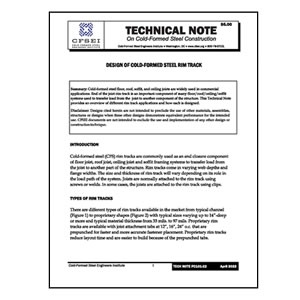
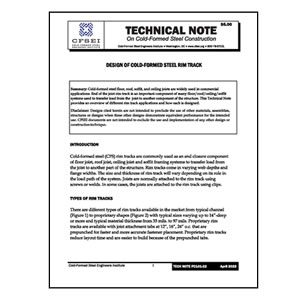
Tech Note FC101-22: Design of Cold-Formed Steel Rim Track
Summary: Cold-formed steel floor, roof, soffit, and ceiling joists are widely used in commercial applications. End of the joist rim track is an important component of many floor/roof/ceiling/soffit systems used to transfer load from the joist to another component of the structure. This Technical Note provides an overview of different rim track applications and how each is designed.
Disclaimer: Designs cited herein are not intended to preclude the use of other materials, assemblies, structures or designs when these other designs demonstrate equivalent performance for the intended use. CFSEI documents are not intended to exclude the use and implementation of any other design or construction technique.